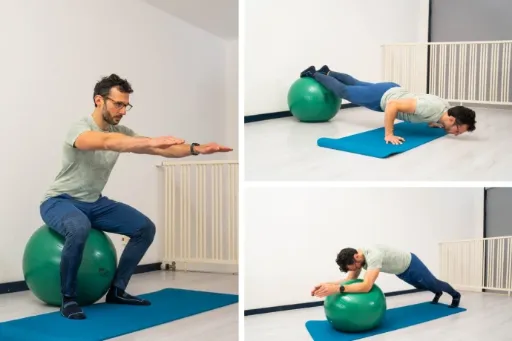
Stability Ball
| Verantwoordelijke | Inge |
|---|---|
| Laatst bijgewerkt | 19-12-2025 |
| Doorlooptijd | 3 minuten |
| Leden | 1 |
Side Plank on Yoga Ball
Purpose:
build lateral core strength and balance.
Starting Position:
Side plank position with the forearm or side of the body supported on the yoga ball.
Feet stacked or staggered for balance.
Execution:
Lift the hips into a side plank position.
Hold the body in a straight line.
Breathe calmly and maintain control.
Common Mistakes:
Hips sagging
Over-tension in the neck
Unstable shoulder position
Coaching Tip:
push actively into the ball to stay stable.
Purpose:
challenge core stability, shoulder control, and balance.
Starting Position:
High plank with both hands placed on the floor.
Feet on the ball, body aligned.
Execution:
Lift one foot and tap the floor next to the ball.
Return the foot to the starting position.
Alternate sides with control.
Common Mistakes:
Excessive hip rotation
Shifting weight too far
Moving too fast
Coaching Tip:
think “quiet hips, controlled feet.”
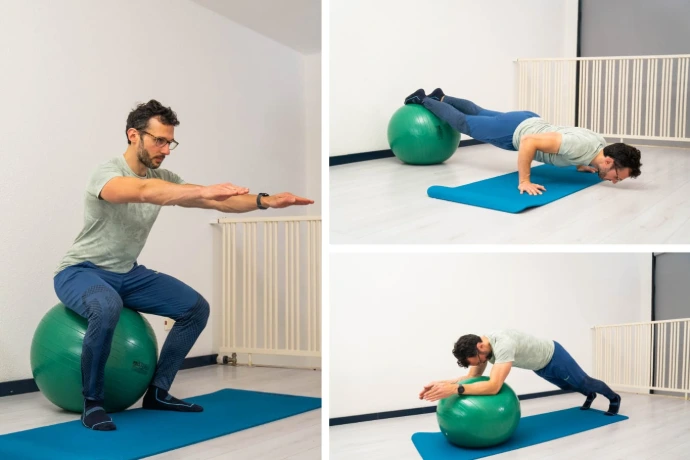
Purpose:
improve core stability, hip control, and coordination.
Starting Position:
High plank position with forearms on the ball.
Body in a straight line.
Execution:
Bring one knee forward to lightly tap the yoga ball.
Return the leg to plank position.
Alternate legs while keeping the torso stable.
Common Mistakes:
Hips lifting or sagging
Rushing the knee tap
Losing plank alignment
Coaching Tip:
move slowly and keep the pelvis as still as possible.
Purpose:
challenge core stability, coordination, and lower-body control.
Starting Position:
High plank with hands on the floor.
Feet starting close together on the ball.
Execution:
Move one foot outward to tap the ground as far as possible.
Return it to center and switch sides.
Keep hips stable throughout.
Common Mistakes:
Pelvis rotating
Rushing the movement
Losing plank alignment
Coaching Tip:
slow the movement down to increase core demand.
Purpose:
strengthen the core and shoulders through anti-extension control.
Starting Position:
Forearm plank with elbows on the yoga ball.
Feet on the floor, body in a straight line.
Execution:
Slowly roll the ball forward by extending the shoulders.
Pull the ball back to the starting position using the core and shoulders.
Keep the lower back neutral.
Common Mistakes:
Lower back arching
Moving too far forward
Losing tension
Coaching Tip:
only roll as far as you can while maintaining a flat torso.
Purpose:
increase shoulder stability, core control, and coordination.
Starting Position:
Forearm plank with both elbows placed on the yoga ball.
Body aligned, core engaged.
Execution:
Draw small controlled circles with the elbows, moving the ball.
Keep hips and shoulders as still as possible.
Change direction after several repetitions.
Common Mistakes:
Circles that are too large
Excessive hip movement
Holding breath
Coaching Tip:
smaller circles = more control and more core activation.
Purpose:
improve shoulder stability, core strength, and upper-body control.
Starting Position:
Start in a high plank position.
Both forearms placed on the yoga ball, arms slightly rotated outward.
Body in a straight line from head to heels.
Execution:
Hold the plank position with one arm pointing outward, then switch sides.
Maintain steady pressure into the ball.
Keep hips level and core engaged.
Common Mistakes:
Shoulders shrugging
Hips sagging
Coaching Tip:
press actively into the ball to stabilise the shoulders.
Purpose:
strengthen core, shoulders, and hip stabilisers.
Starting Position:
High plank position with feet resting on the yoga ball.
Forearms on the floor.
Execution:
Hold the plank or perform small controlled adjustments.
Maintain a straight body line.
Common Mistakes:
Sagging hips
Ball rolling excessively
Coaching Tip:
brace the core before you move.
Purpose:
improve shoulder stability and core control.
Starting Position:
High plank position with both hands on the yoga ball.
Execution:
Roll the ball slightly to one side.
Bring it back to center and roll to the other side.
Common Mistakes:
Bending the elbows
Losing plank alignment
Coaching Tip:
small movements create more challenge.
Purpose:
challenge core stability and shoulder control.
Starting Position:
Forearm plank with elbows on the floor.
Feet on the yoga ball.
Execution:
Lift one leg and tap the ground next to the ball.
Return to plank and switch legs.
Common Mistakes:
Shifting weight excessively
Coaching Tip:
keep hips square to the floor.
Purpose:
improve balance and deep core activation.
Starting Position:
Sit on the yoga ball.
Slowly lift both feet off the floor.
Execution:
Hold the balanced position.
Keep spine tall and core engaged.
Common Mistakes:
Holding breath
Collapsing posture
Coaching Tip:
think “tall spine, relaxed shoulders.”
Purpose:
improve core rotation control and spinal mobility.
Starting Position:
Sit upright on the yoga ball.
Feet flat on the floor, hands together or arms extended.
Execution:
Rotate the torso to one side.
Return to center and rotate to the other side.
Common Mistakes:
Moving the hips instead of the torso
Rushing the movement
Coaching Tip:
rotate through the rib cage, not the shoulders alone.
Purpose:
improve unilateral hip control and core stability.
Starting Position:
Lie on your back.
One leg bent, the other guiding the yoga ball against the wall.
Execution:
Use one leg to lift or guide the ball upward against the wall.
Lower it back down with control.
Alternate legs.
Common Mistakes:
Jerky movements
Pelvic rotation
Coaching Tip:
move slowly and stay symmetrical.